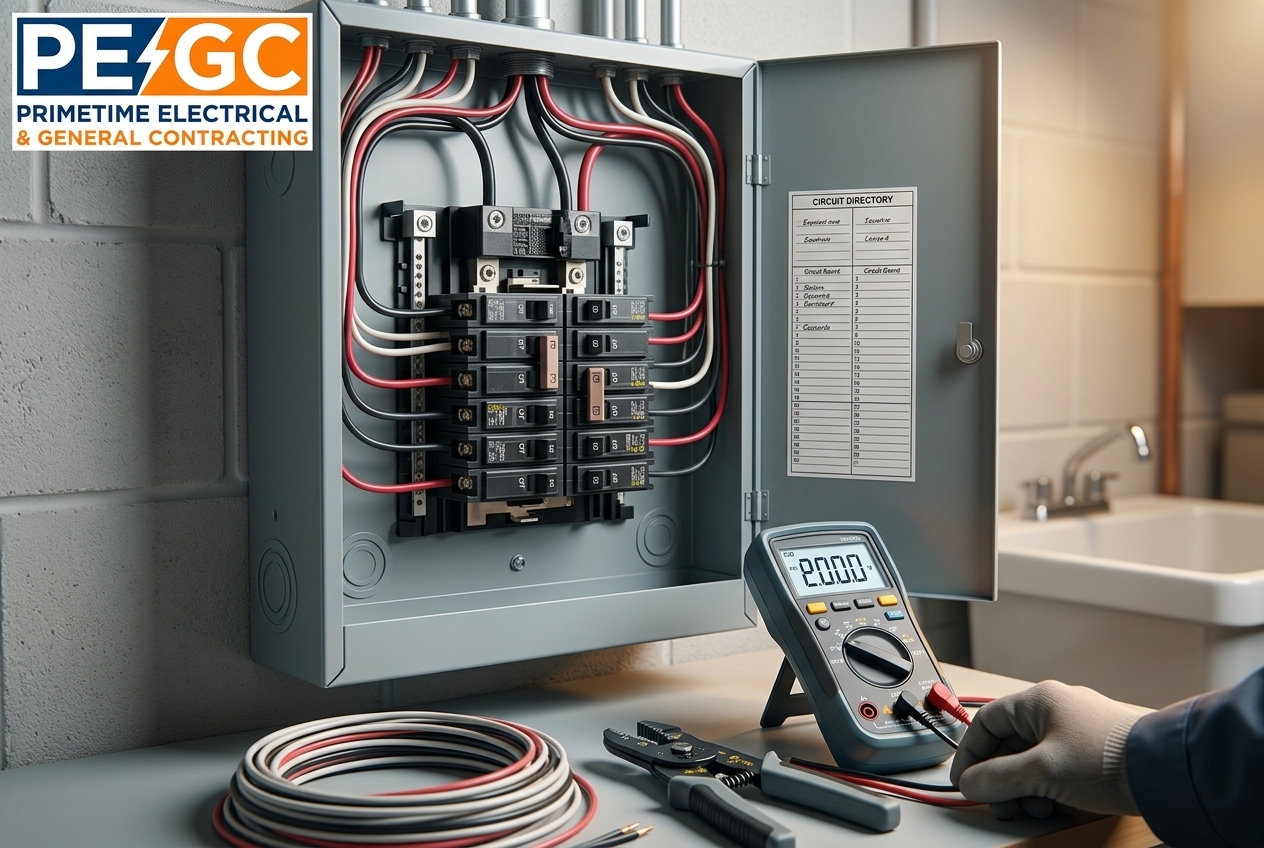
If you’ve made one too many trips to the basement to flip a breaker back on, you already know how frustrating a nuisance trip can be. The good news: a tripping breaker isn’t your home misbehaving — it’s your electrical system doing exactly what it was designed to do. The breaker is protecting you. The real question is why it keeps having to.
At Primetime Electrical and General Contracting, we troubleshoot tripping breakers in homes across Sterling Heights, Macomb County, and Oakland County every week. Here’s what’s usually going on, what you can safely check yourself, and when it’s time to call a licensed electrician.
First, What a Circuit Breaker Actually Does
Your electrical panel is the heart of your home’s wiring. Each breaker controls a circuit — a loop of wiring that feeds outlets, lights, or a specific appliance. A breaker’s job is to cut power the instant something goes wrong, before overheated wiring can start a fire or deliver a dangerous shock.
So when a breaker trips, it’s not failing. It’s succeeding. Understanding which kind of fault triggered it is the key to fixing the problem for good.
The Most Common Reasons Breakers Keep Tripping
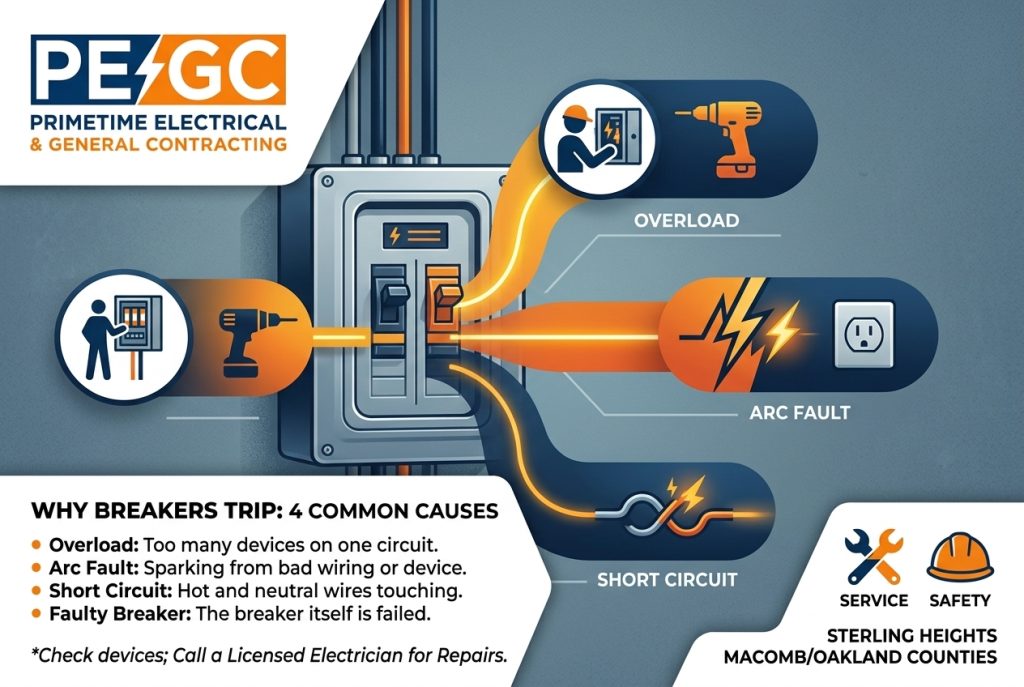
1. Circuit Overload
This is by far the most common cause. Every circuit has a limit — typically 15 or 20 amps in a home. When you plug in too many power-hungry devices on the same circuit, you exceed that limit, and the breaker trips to prevent the wires from overheating.
Classic culprits include space heaters, hair dryers, microwaves, and window air conditioners — especially when several run at once. If your breaker trips every time you use the microwave and the toaster together, you’ve almost certainly found an overload.
What you can do: Spread high-wattage devices across different circuits and outlets. If you constantly run out of capacity, though, the underlying issue is that your home simply needs more circuits or a panel upgrade.
2. Short Circuits
A short circuit happens when a hot wire touches a neutral wire, allowing a sudden surge of current to flow. This is more serious than an overload. You might notice a burning smell, discoloration around an outlet, or a breaker that trips the instant you reset it.
Short circuits can come from damaged wiring, a faulty appliance, or pests chewing through insulation inside your walls. This is not a DIY fix — it requires a professional to safely locate and repair the fault.
3. Ground Faults
A ground fault is similar to a short circuit, but here the hot wire contacts a ground wire or a grounded part of the system — often in damp areas like kitchens, bathrooms, garages, or outdoor outlets. That’s exactly why modern code requires GFCI protection in those locations.
If a GFCI outlet or breaker keeps tripping, it may be doing its job by detecting moisture or a genuine fault. Persistent ground faults should always be inspected, since they pose a real shock hazard.
4. An Aging or Undersized Electrical Panel
Many homes in Southeast Michigan were wired for a different era. If your house still runs on a 60- or 100-amp panel — or you have an older brand of panel known for reliability problems — it may simply lack the capacity for modern living: EV chargers, central air, hot tubs, home offices, and a kitchen full of appliances.
Frequent tripping, a warm panel, flickering lights, or breakers that feel loose are all signs your panel is overdue for an upgrade. A modern panel restores capacity, improves safety, and brings your home up to code.
5. A Failing Breaker
Breakers don’t last forever. After years of tripping and resetting, the internal mechanism can wear out and start tripping at lower loads than it should — or fail to trip when it needs to, which is even more dangerous. A worn breaker is an inexpensive part to replace, but it should always be done by a licensed electrician.
What You Can Safely Check Yourself
Before calling in a pro, there are a few safe steps a homeowner can take:
Unplug everything on the affected circuit, reset the breaker, then plug devices back in one at a time. If the breaker trips the moment a specific appliance kicks on, that appliance is likely the problem. If it trips with nothing plugged in, the issue is in the wiring or the breaker itself — and that’s your cue to call an electrician.
What you should never do is repeatedly force a breaker back on that keeps tripping, replace a breaker with a higher-amperage one to “stop the nuisance,” or open the panel and poke around inside. Those moves remove the very protection keeping your home safe and can lead to fire or electrocution.
When to Call a Licensed Electrician
It’s time to bring in a professional if you notice any of the following: a breaker that trips repeatedly or won’t reset, a burning smell or scorch marks near outlets or the panel, a warm or buzzing panel, flickering lights throughout the house, or sparking outlets. These are warning signs that something more serious is happening behind your walls.
Electrical troubleshooting is part detective work, part safety science. A trained electrician can test circuits, isolate the fault, and fix the root cause — not just the symptom — so you stop making trips to the panel for good.
Get to the Root of It with Primetime Electrical
Primetime Electrical and General Contracting is a locally and veteran owned, fully licensed and insured team serving Sterling Heights and more than 30 communities across Macomb, Oakland, and Metro Detroit. With 8+ years of experience and a 5-star Google rating, we diagnose tripping breakers fast and fix them right the first time — whether the answer is a simple breaker replacement, a dedicated new circuit, or a full panel upgrade.
If your breakers keep tripping, don’t keep guessing. Call us 24/7 at (810) 397-2401 or request a free in-home estimate. We’ll find out exactly why — and make your home safe again.