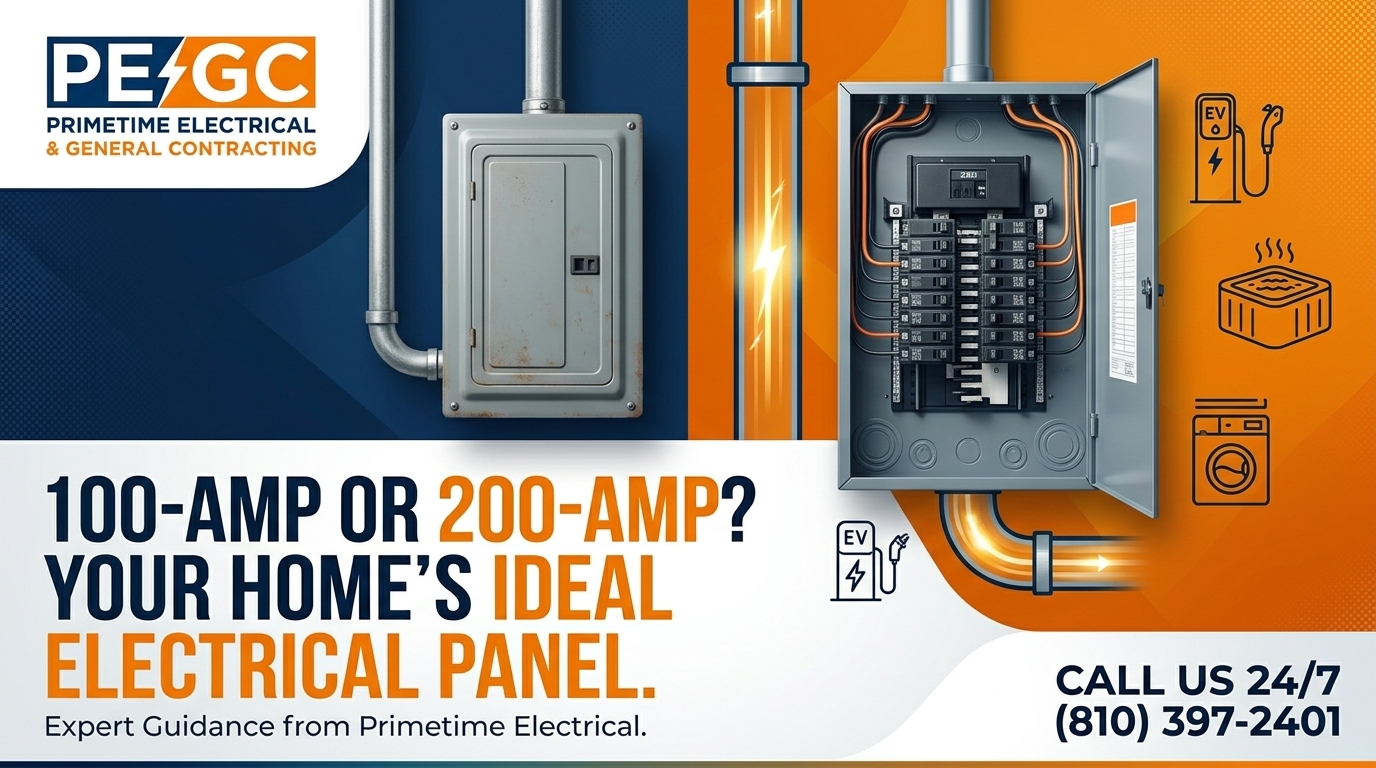
If you’ve started shopping for an EV charger, a hot tub, central air, or a kitchen remodel, you’ve probably run into the same question: is my electrical panel big enough? For most homeowners that comes down to a choice between a 100-amp and a 200-amp service panel. Picking the right one affects your home’s safety, its resale value, and whether you’ll be calling an electrician again in a few years to redo the work.
At Primetime Electrical and General Contracting, we size and install panels for homes across Sterling Heights and the surrounding Macomb and Oakland County communities every week. Here’s a straightforward breakdown to help you understand which one fits your home.
What “Amps” Actually Means for Your Home
Your electrical panel — sometimes called the breaker box or service panel — is the gateway for all the power entering your home. The amperage rating tells you the maximum amount of electricity it can safely deliver at one time. A 100-amp panel can handle up to 100 amps of simultaneous demand; a 200-amp panel doubles that headroom.
Think of it like the plumbing in your house. A bigger pipe doesn’t make you use more water, but it lets more flow when you need it. The same is true here: a 200-amp panel doesn’t raise your electric bill on its own. It simply gives your home the capacity to run more things at once without straining the system.
When a 100-Amp Panel Is Enough
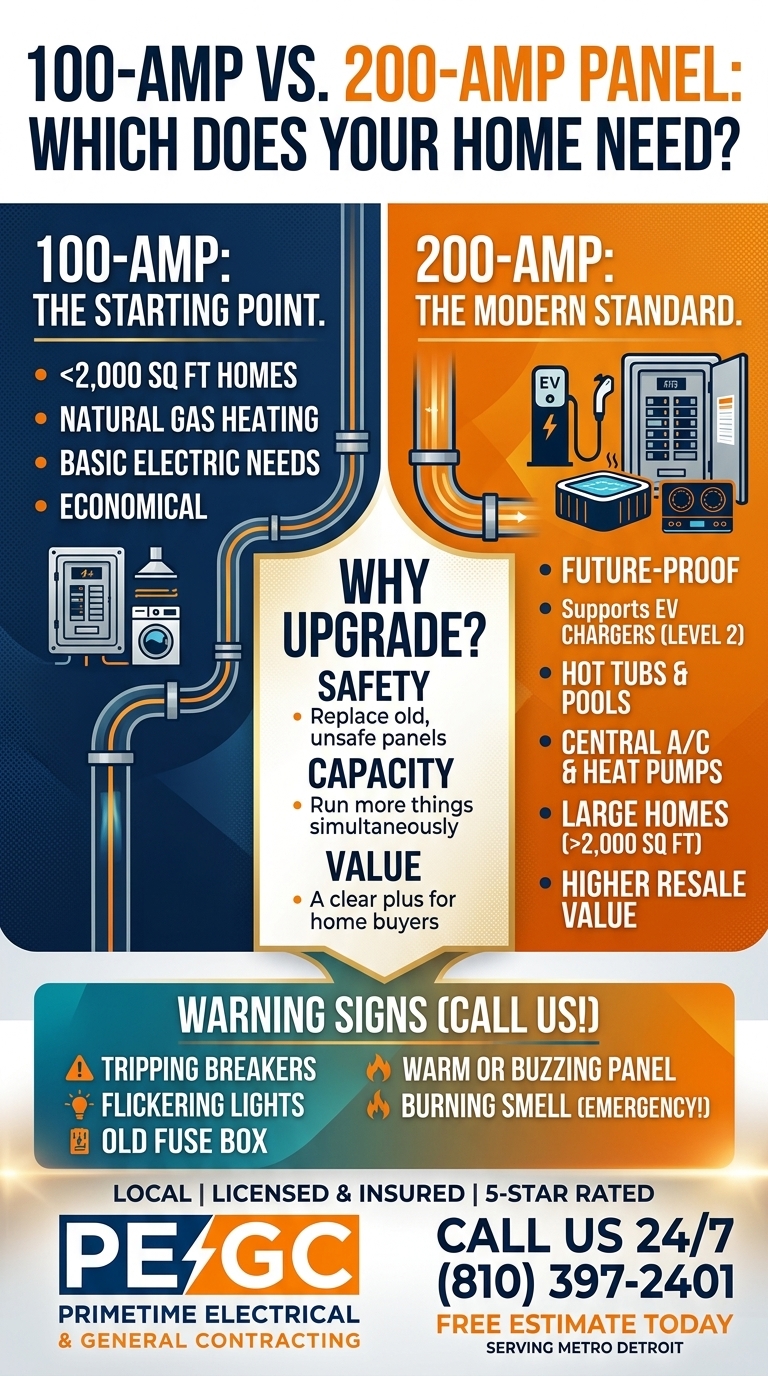
A 100-amp panel isn’t automatically outdated. For some homes it’s perfectly adequate. You may be fine with 100 amps if your home is on the smaller side (roughly under 2,000 square feet), you heat with natural gas rather than electricity, you don’t plan to add major electric loads, and you’re not running an EV charger, electric vehicle, hot tub, or electric heat.
The catch is that modern households keep adding electric loads, and 100 amps fills up faster than people expect. If your panel is already crowded — or your lights dim and breakers trip when big appliances kick on — you may already be at the ceiling of what 100 amps can comfortably support.
When You Should Step Up to 200 Amps
For most homes today, 200 amps has become the practical standard. It’s worth the upgrade if any of these apply to you:
You’re installing an EV charger. Level 2 home chargers draw a significant, sustained load that 100-amp panels often can’t accommodate alongside everything else. You’re adding central air conditioning, electric heat, or a heat pump. You’re putting in a hot tub, pool, or workshop. You’re doing a kitchen or home addition that adds ovens, induction cooktops, or new circuits. Your home is larger (generally over 2,000 square feet). Or your panel is simply old, full, or showing its age.
A 200-amp service gives you room to grow, supports today’s higher-demand appliances, and is what most buyers and home inspectors expect to see. If you anticipate any of the above within the next several years, upgrading once to 200 amps is far cheaper than upgrading to 150 now and 200 later.
Signs Your Current Panel Needs Attention
Capacity isn’t the only reason to upgrade. Sometimes the panel itself is the problem. Watch for these warning signs: breakers that trip frequently, lights that flicker or dim when appliances start, a warm or buzzing panel, scorch marks or a burning smell, an old fuse box instead of breakers, or a known problem-brand panel. Any of these is worth a professional look — our circuit breaker and panel upgrade team can assess whether you need a new panel, more circuits, or a full service upgrade.
If you ever notice sparking, a burning smell, or a hot panel, don’t wait — that’s a job for a 24/7 emergency electrician.
What a Panel Upgrade Involves
Upgrading from 100 to 200 amps is more than swapping a box. It typically means installing a new panel, often a new meter base and service entrance cable, and coordinating with the utility to reconnect at the higher rating. It’s skilled, code-regulated work that has to pass inspection — and it’s not a DIY project. In an older home, an upgrade is also a good moment to evaluate whether any aging wiring should be addressed at the same time, and whether whole-home surge protection makes sense to protect your investment.
A properly done upgrade improves safety, removes the bottleneck on your home’s power, and adds real value — most buyers see a modern 200-amp service as a clear plus.
Not Sure Which You Need? Let’s Take a Look
The honest answer to “100 or 200 amps?” depends on your home’s size, how you heat it, what you run today, and what you plan to add tomorrow. Rather than guess, the smartest move is a quick assessment from a licensed electrician who can calculate your actual load and recommend the right size — no overselling, no surprises.
Primetime Electrical and General Contracting is locally owned, fully licensed and insured, and 5-star rated, with 8+ years powering homes across Sterling Heights, Macomb, Oakland, and Metro Detroit. We’ll size your panel correctly the first time.
Call us 24/7 at (810) 397-2401 or request your free in-home estimate today.