Author: Primetime Electrical

  • 9 Landscape Lighting Ideas to Transform Your Michigan Home After Dark

    9 Landscape Lighting Ideas to Transform Your Michigan Home After Dark

    Good landscape lighting does three things at once: it makes your home safer, more secure, and dramatically more beautiful. And in Michigan, where winter darkness sets in by late afternoon and summer evenings stretch long on the patio, the right outdoor lighting earns its keep all year round.

    Whether you want to highlight a beautiful façade, light a path to the front door, or turn your backyard into an evening retreat, here are nine landscape lighting ideas that work especially well for Michigan homes — plus what to keep in mind with our climate.

    At Primetime Electrical and General Contracting, we design and install outdoor and landscape lighting across Sterling Heights and the surrounding communities, so let’s get into the ideas.

    1. Path and Walkway Lighting
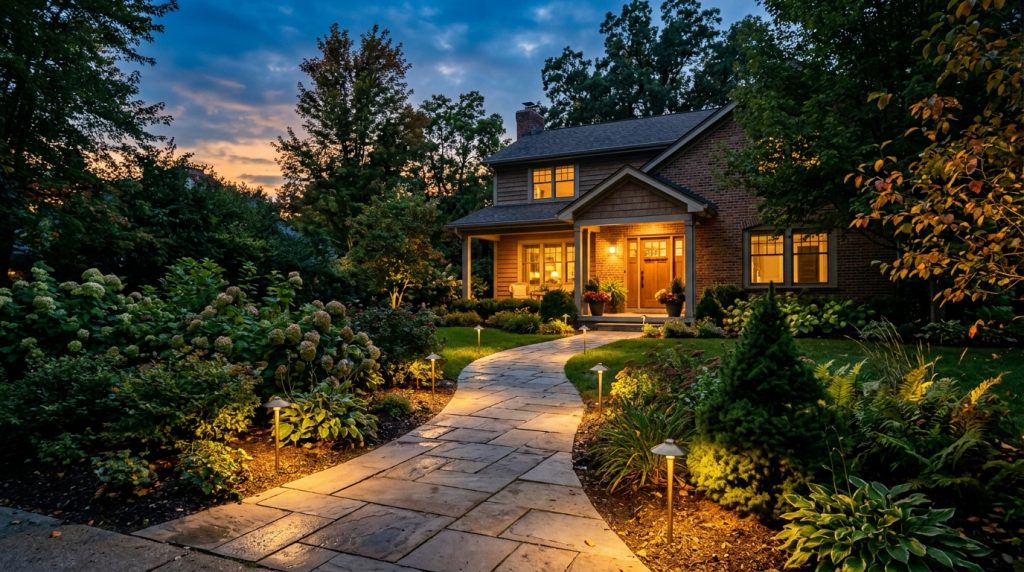
    low path lights lining a front walkway at dusk

    The most practical place to start. Low fixtures spaced along walkways, driveways, and garden paths guide guests safely to your door and prevent missteps on icy Michigan evenings. Aim for a soft, even wash of light rather than a runway of bright dots — warm, gentle spacing looks far more elegant and keeps the focus on your home.

    Spacing matters more than brightness here — fixtures placed roughly six to eight feet apart create overlapping pools of light with no dark gaps between them, which is exactly what you want on an icy walk. Copper or brass fixtures hold up beautifully against Michigan winters and develop a handsome patina over time, while cheaper plastic units tend to fade and crack after a season or two. If your front walk curves, follow the curve with your lights to gently lead the eye (and your guests) toward the door.

    2. Uplighting on Trees and Architecture

    a mature tree uplit from the base, branches glowing against the night sky

    Uplighting places fixtures at ground level and aims them upward to graze a tree trunk, a stone chimney, or an architectural column. It adds instant drama and depth, turning a single mature oak or a brick façade into a nighttime centerpiece. This is one of the highest-impact moves in any landscape lighting plan.

    The angle and distance of the fixture change the entire effect: place it close to a textured surface for dramatic shadows, or pull it back for a softer, broader glow. Evergreens, mature maples, and oaks are ideal candidates because their structure looks striking lit from below, even in winter when bare branches cast their own dramatic patterns. Two or three fixtures around a single large tree create dimension that a single light can’t match.

    3. Façade and Wall Washing
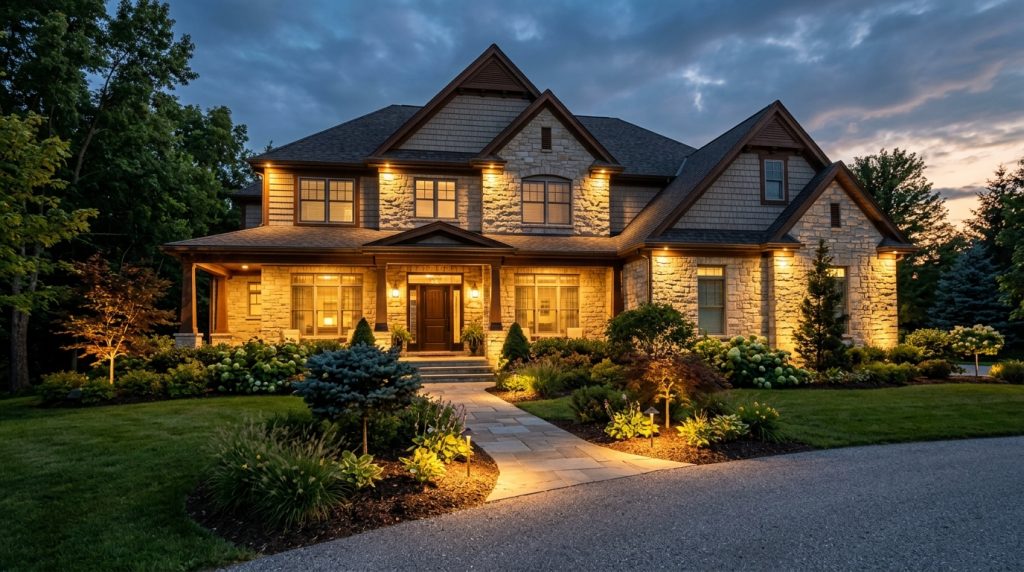
    warm light washing evenly across a home's front exterior

    Wall washing uses wider beams to bathe the front of your home in soft, even light. It highlights texture — brick, stone, siding — and gives the whole property a welcoming glow from the street. It’s also one of the most effective ways to boost curb appeal and evening security at the same time.

    The trick to good wall washing is even coverage — fixtures spaced too far apart leave bright hotspots and dark valleys that flatten the look. Warm-toned LEDs (around 2700K) flatter brick and natural stone, while cooler tones can make a home feel stark, so the color temperature is worth getting right. Done well, wall washing also fills in the shadowy zones around your home where intruders would otherwise hide.

    4. Deck, Patio, and Step Lighting
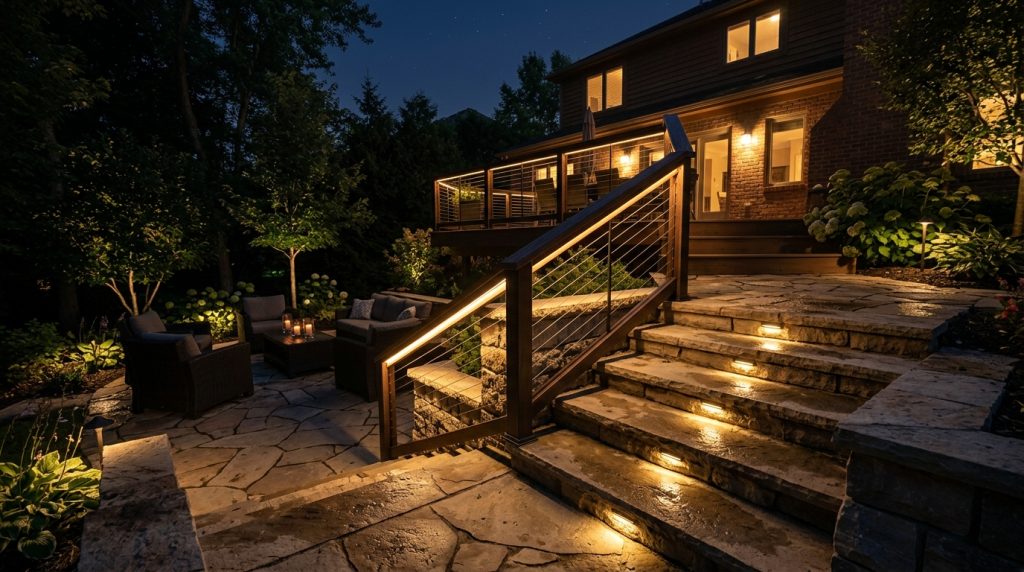
    recessed step lights and railing lights on an evening patio

    Few upgrades extend your living space like lighting your outdoor entertaining areas. Recessed lights tucked into steps, under railings, or beneath bench seating create a warm, usable space for those long Michigan summer nights — and they prevent trips and falls on stairs after dark.

    Layering is key outdoors just as it is inside: combine low step lights for safety, railing lights for ambiance, and a brighter source near the grill or seating area for function. Warm, dimmable fixtures let you shift the mood from a lively gathering to a quiet nightcap without flipping the whole yard on. Building the wiring in during a deck project is far cleaner and cheaper than retrofitting it later.

    5. Moonlighting for a Natural Glow

    dappled light falling through tree branches onto a lawn

    Moonlighting mounts soft fixtures high in your trees, aimed downward through the branches. The result is a gentle, dappled glow that mimics natural moonlight falling across the yard. It’s subtle, romantic, and one of the most sophisticated effects in landscape design.

    Because the fixtures sit high in the canopy, the light filters through leaves and branches to cast gentle, shifting shadows on the ground — an effect that feels completely natural rather than staged. It works beautifully over patios, seating areas, and lawns where you want illumination without an obvious light source in view. The taller and fuller the tree, the more convincing the moonlight effect becomes.

    6. Water Feature and Garden Bed Lighting
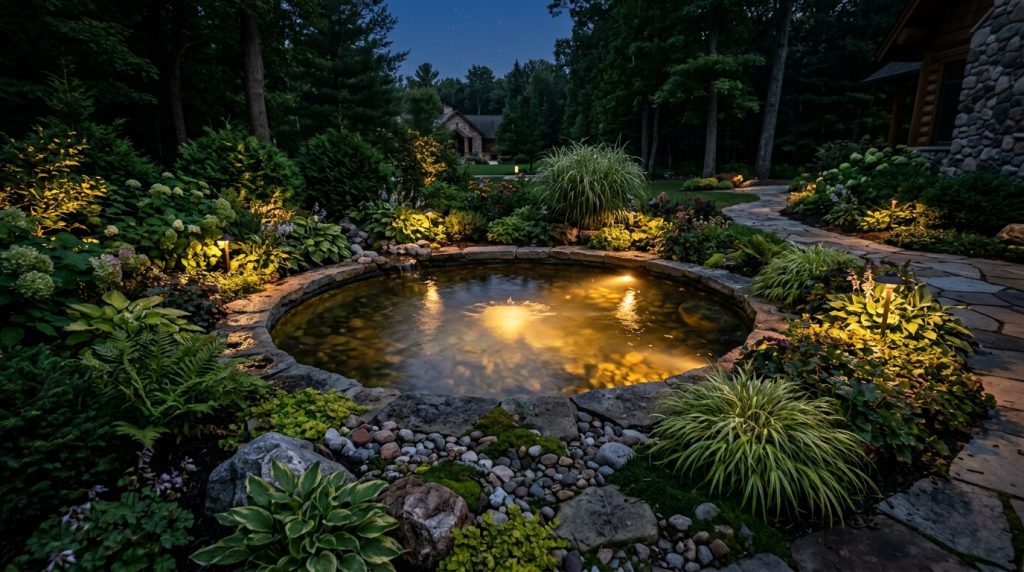
    a small pond or fountain lit from within, surrounded by planted beds

    If you have a pond, fountain, or detailed garden beds, dedicated fixtures bring them to life after sunset. Lighting reflected off moving water adds movement and sparkle, while well-placed bed lights showcase your planting through every season — even highlighting fresh snow in winter.

    Submersible fixtures lighting a fountain or pond from within create reflection and sparkle that draw the eye straight to the feature. In garden beds, angling lights across (rather than straight down on) your plantings reveals texture and depth, and the same fixtures look striking when fresh snow blankets the beds in winter. Seasonal plants change through the year, so a few adjustable fixtures let you re-aim as your garden grows.

    7. Security and Motion Lighting
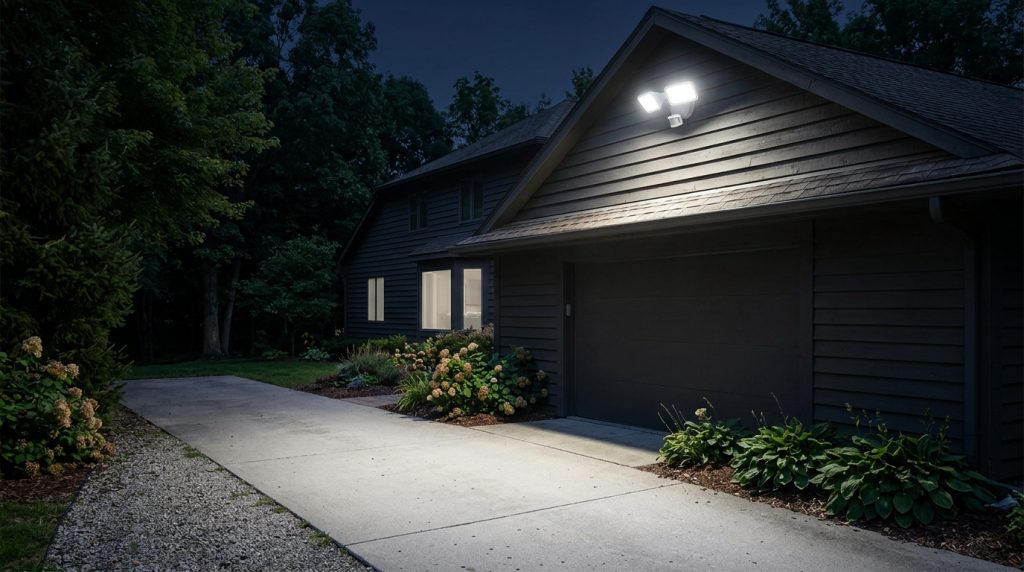
    a bright motion-activated fixture illuminating a side yard and driveway

    Beauty aside, lighting is one of the simplest, most effective deterrents to intruders. Motion-activated fixtures at entry points, garages, and dark side yards add a real layer of protection. Thoughtful placement keeps your property secure without flooding the whole yard in harsh light. Pair it with home surge protection to shield your outdoor electrical investments from Michigan’s storm-season power swings.

    The most effective placements are the spots you can’t easily see — side yards, the back of the garage, basement-window wells, and any approach hidden from the street. Modern motion fixtures let you set sensitivity and duration so a passing cat doesn’t trigger them but a person does. Pairing motion lights with steady, lower-level ambient lighting gives you security without the harsh, all-or-nothing floodlight effect that annoys neighbors.

    8. Holiday-Ready Outdoor Outlets
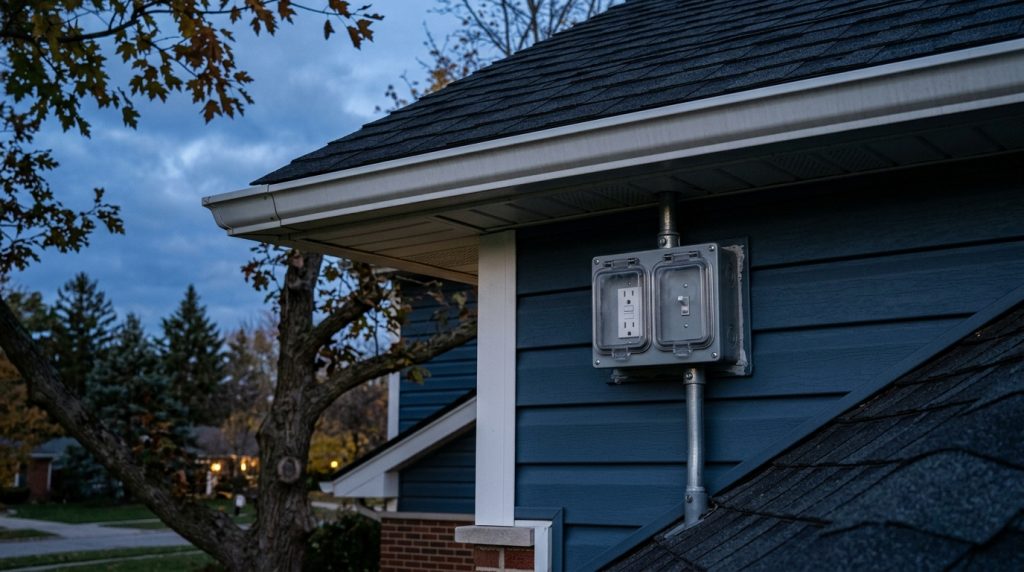
    a weatherproof exterior outlet with a switch, near the roofline

    Michigan does the holidays right — so plan for them. Adding switched, weatherproof exterior outlets (and even soffit outlets near the roofline) makes seasonal decorating safe and effortless, with no extension cords running out a window. It’s a small electrical addition that pays off every December. Our lighting installation team can wire these in cleanly.

    A single switch inside the house controlling your exterior holiday outlets means no more crawling behind bushes to plug and unplug strings of lights. Soffit outlets near the roofline make hanging rooflines and gutters genuinely safe, eliminating the cords and ladders that send people to the ER every December. Adding these during warmer months means they’re ready and waiting long before the first snow.

    9. Smart, Zoned, and Timer Controls
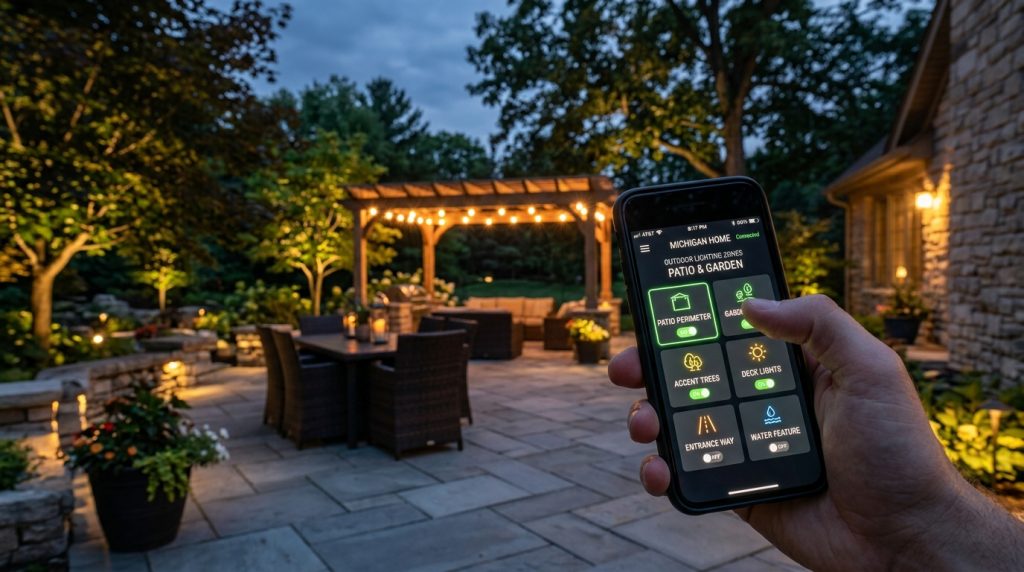
    a smartphone app controlling outdoor lighting zones

    Modern landscape lighting can be zoned, dimmed, scheduled, and controlled from your phone. Set paths to come on at dusk, dial the patio up for a gathering, and let everything power down automatically overnight. Smart controls add convenience and keep energy use efficient year-round.

    Grouping your lighting into zones — path, façade, patio, security — lets you control each area independently for both mood and efficiency, so you’re never lighting the whole property when you only need the walkway. Astronomic timers automatically adjust to Michigan’s shifting sunset times, dimming or powering down without you touching a thing. Many systems also integrate with smart-home platforms, so your outdoor lighting works alongside the rest of your home.

    A Few Michigan-Specific Tips

    Our climate asks a little more of outdoor lighting. Choose fixtures rated for cold, wet, and freeze-thaw conditions — cheap fixtures crack and corrode after a Michigan winter. LED bulbs are the clear choice here: they shrug off the cold, last for years, and sip energy. And because outdoor wiring is exposed to moisture, ice, and lawn equipment, it should always be installed to code by a licensed electrician — both for safety and so it lasts.

    Let’s Light Up Your Property

    The best landscape lighting plans layer a few of these ideas together — a little path lighting, some uplighting, a wash on the façade — for a result that’s safe, secure, and stunning. The key is a thoughtful design and a clean, code-compliant install built to handle Michigan weather.

    Primetime Electrical and General Contracting is locally owned, fully licensed and insured, and 5-star rated, serving Sterling Heights and communities across Macomb, Oakland, and Metro Detroit. We’ll help you design lighting you’ll enjoy every evening of the year.

    Call us 24/7 at (810) 397-2401 or request your free in-home estimate today.
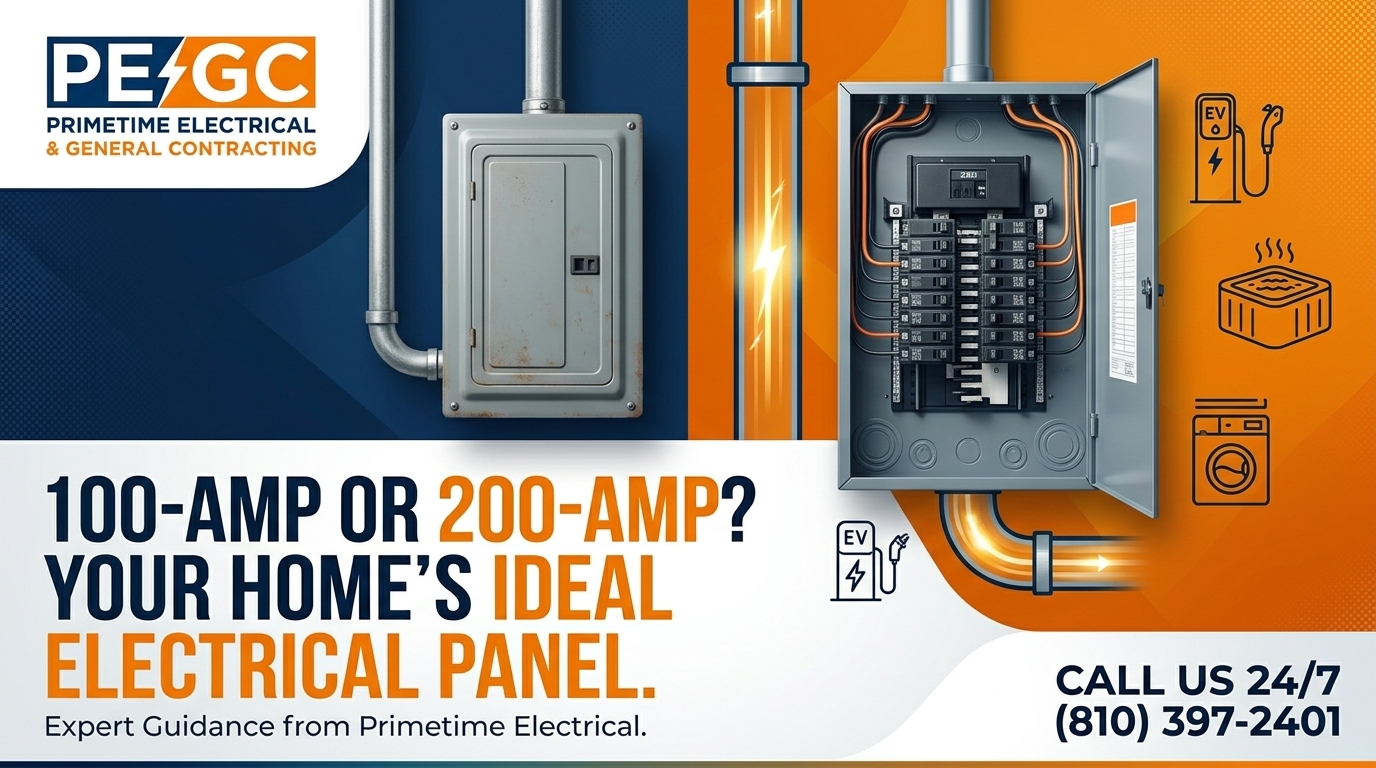
  • 100-Amp vs. 200-Amp Panel: Which One Does My Home Need?

    100-Amp vs. 200-Amp Panel: Which One Does My Home Need?

    If you’ve started shopping for an EV charger, a hot tub, central air, or a kitchen remodel, you’ve probably run into the same question: is my electrical panel big enough? For most homeowners that comes down to a choice between a 100-amp and a 200-amp service panel. Picking the right one affects your home’s safety, its resale value, and whether you’ll be calling an electrician again in a few years to redo the work.

    At Primetime Electrical and General Contracting, we size and install panels for homes across Sterling Heights and the surrounding Macomb and Oakland County communities every week. Here’s a straightforward breakdown to help you understand which one fits your home.

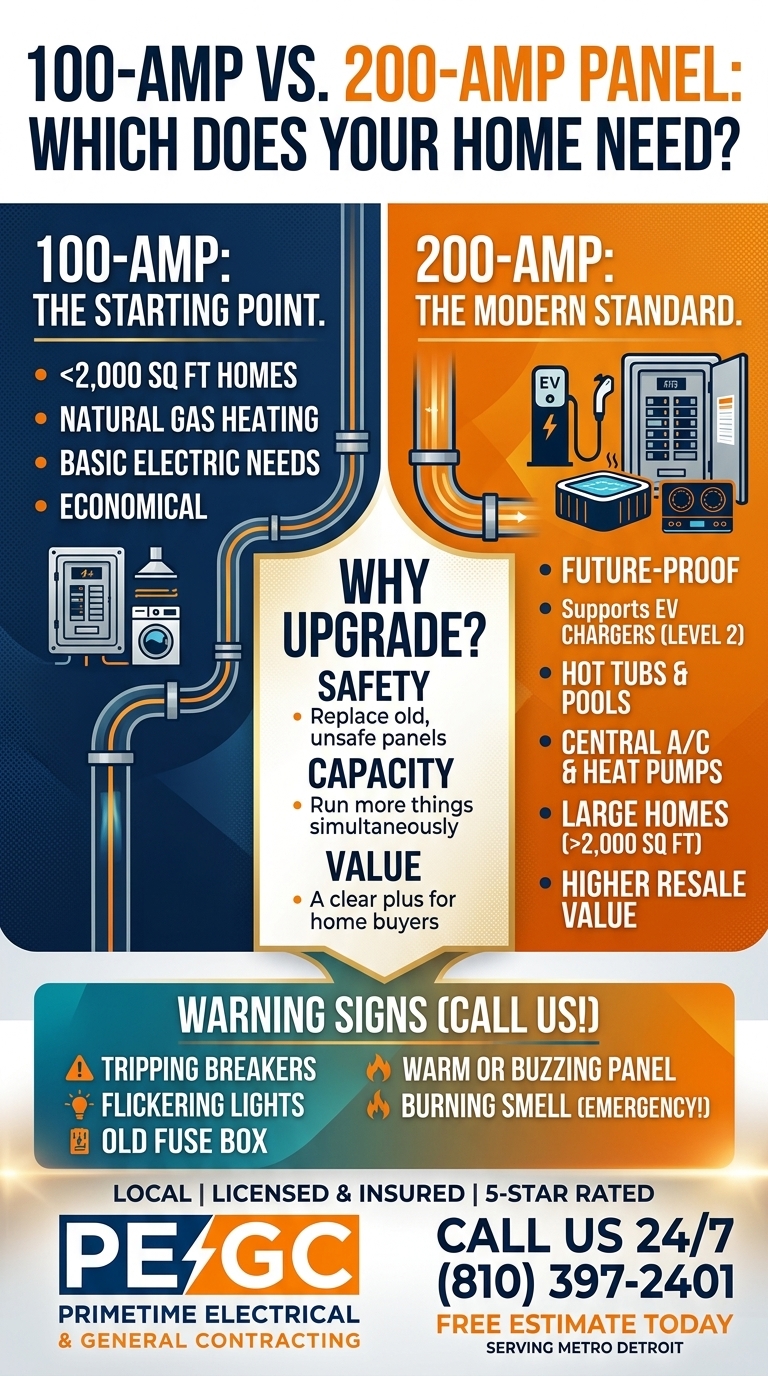
    100-Amp vs. 200-Amp Panel

    What “Amps” Actually Means for Your Home

    Your electrical panel — sometimes called the breaker box or service panel — is the gateway for all the power entering your home. The amperage rating tells you the maximum amount of electricity it can safely deliver at one time. A 100-amp panel can handle up to 100 amps of simultaneous demand; a 200-amp panel doubles that headroom.

    Think of it like the plumbing in your house. A bigger pipe doesn’t make you use more water, but it lets more flow when you need it. The same is true here: a 200-amp panel doesn’t raise your electric bill on its own. It simply gives your home the capacity to run more things at once without straining the system.

    When a 100-Amp Panel Is Enough

    A 100-amp panel isn’t automatically outdated. For some homes it’s perfectly adequate. You may be fine with 100 amps if your home is on the smaller side (roughly under 2,000 square feet), you heat with natural gas rather than electricity, you don’t plan to add major electric loads, and you’re not running an EV charger, electric vehicle, hot tub, or electric heat.

    The catch is that modern households keep adding electric loads, and 100 amps fills up faster than people expect. If your panel is already crowded — or your lights dim and breakers trip when big appliances kick on — you may already be at the ceiling of what 100 amps can comfortably support.

    When You Should Step Up to 200 Amps

    For most homes today, 200 amps has become the practical standard. It’s worth the upgrade if any of these apply to you:

    You’re installing an EV charger. Level 2 home chargers draw a significant, sustained load that 100-amp panels often can’t accommodate alongside everything else. You’re adding central air conditioning, electric heat, or a heat pump. You’re putting in a hot tub, pool, or workshop. You’re doing a kitchen or home addition that adds ovens, induction cooktops, or new circuits. Your home is larger (generally over 2,000 square feet). Or your panel is simply old, full, or showing its age.

    A 200-amp service gives you room to grow, supports today’s higher-demand appliances, and is what most buyers and home inspectors expect to see. If you anticipate any of the above within the next several years, upgrading once to 200 amps is far cheaper than upgrading to 150 now and 200 later.

    Signs Your Current Panel Needs Attention

    Capacity isn’t the only reason to upgrade. Sometimes the panel itself is the problem. Watch for these warning signs: breakers that trip frequently, lights that flicker or dim when appliances start, a warm or buzzing panel, scorch marks or a burning smell, an old fuse box instead of breakers, or a known problem-brand panel. Any of these is worth a professional look — our circuit breaker and panel upgrade team can assess whether you need a new panel, more circuits, or a full service upgrade.

    If you ever notice sparking, a burning smell, or a hot panel, don’t wait — that’s a job for a 24/7 emergency electrician.

    What a Panel Upgrade Involves

    Upgrading from 100 to 200 amps is more than swapping a box. It typically means installing a new panel, often a new meter base and service entrance cable, and coordinating with the utility to reconnect at the higher rating. It’s skilled, code-regulated work that has to pass inspection — and it’s not a DIY project. In an older home, an upgrade is also a good moment to evaluate whether any aging wiring should be addressed at the same time, and whether whole-home surge protection makes sense to protect your investment.

    A properly done upgrade improves safety, removes the bottleneck on your home’s power, and adds real value — most buyers see a modern 200-amp service as a clear plus.

    Not Sure Which You Need? Let’s Take a Look

    The honest answer to “100 or 200 amps?” depends on your home’s size, how you heat it, what you run today, and what you plan to add tomorrow. Rather than guess, the smartest move is a quick assessment from a licensed electrician who can calculate your actual load and recommend the right size — no overselling, no surprises.

    Primetime Electrical and General Contracting is locally owned, fully licensed and insured, and 5-star rated, with 8+ years powering homes across Sterling Heights, Macomb, Oakland, and Metro Detroit. We’ll size your panel correctly the first time.

    Call us 24/7 at (810) 397-2401 or request your free in-home estimate today.
  • Why Do My Lights Flicker When the AC Turns On?

    Why Do My Lights Flicker When the AC Turns On?

    You’re sitting in the living room on a hot Michigan afternoon, the central air kicks on, and for a split second every light in the house dims. If that quick flicker has you wondering whether something’s wrong, you’re asking the right question. Sometimes it’s perfectly normal. Other times, it’s an early warning sign worth taking seriously.

    At Primetime Electrical and General Contracting, we get this call all summer long from homeowners across Sterling Heights and the surrounding Macomb and Oakland County communities. Here’s why it happens, when it’s harmless, and when it’s time to have an electrician take a look.

    The Short Answer: Inrush Current

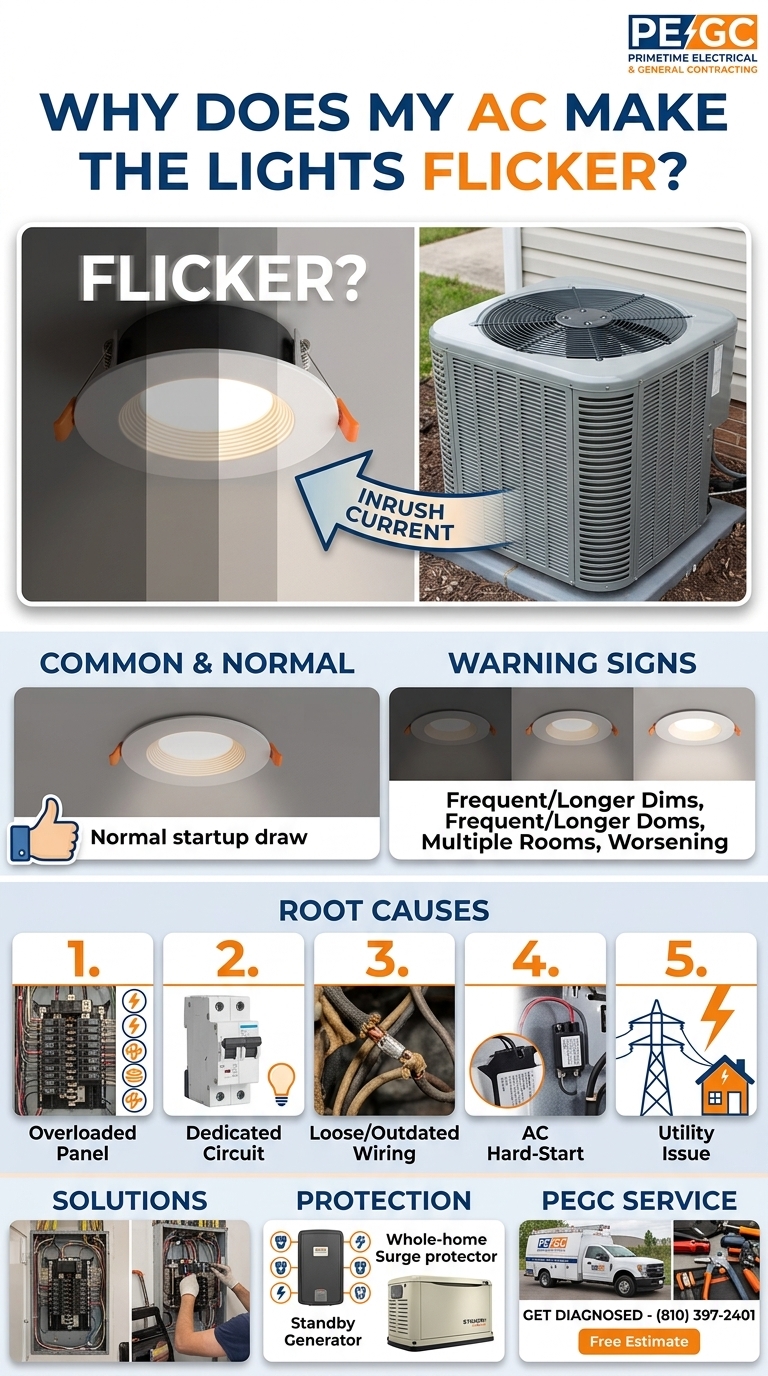
    Your air conditioner’s compressor is one of the most power-hungry devices in your entire home. The moment it starts up, it pulls a large surge of electricity — often several times its normal running load — to get the motor spinning. Electricians call this “inrush current.”

    That brief, heavy draw can cause a momentary dip in voltage across your home’s wiring. Lights on the same electrical system react to that dip by dimming for a fraction of a second. A quick, slight flicker right as the AC engages is common and usually nothing to worry about.

    The concern is when the flickering is frequent, dramatic, or getting worse over time. That’s when it shifts from a quirk to a symptom.

    flickering lights infographic

    When Flickering Is a Warning Sign

    A healthy electrical system should absorb the AC’s startup surge with only a barely-noticeable blip. If you’re seeing any of the following, something deeper may be going on:

    The lights dim noticeably or for longer than a quick flash. Multiple rooms flicker, not just the ones near the AC unit. The flickering has gotten worse over recent months. You also notice flickering when other large appliances start — the dryer, microwave, or refrigerator. Flickering comes with other symptoms like warm outlets, a buzzing panel, or breakers that keep tripping.

    When the pattern looks like this, the dimming is telling you that your system is straining to deliver power. Our electrical troubleshooting team can pinpoint exactly which of the causes below is to blame.

    Common Causes Behind the Flicker

    1. An Overloaded or Undersized Electrical Panel

    If your AC shares its electrical demand with the rest of the house through an aging or undersized panel, the system simply may not have the headroom to handle that startup surge cleanly. Many older Southeast Michigan homes were never wired for the central air, EV chargers, and appliance loads we run today.

    circuit breaker and panel upgrade increases your home’s capacity so large loads like your AC start up without dragging down everything else.

    2. The AC Needs Its Own Dedicated Circuit

    Central air conditioners and other major appliances should run on a dedicated circuit — a line that serves nothing else. If your AC is sharing a circuit with lighting or outlets, its startup surge will visibly affect those lights every time. Adding a properly sized dedicated circuit is a common, straightforward fix.

    3. Loose or Outdated Wiring

    Loose connections at the panel, at outlets, or within the wiring itself create resistance, and resistance shows up as flickering — and as a genuine fire risk. Homes with original outdated wiring are especially prone to this. If your home is a few decades old and you’ve never had the wiring evaluated, flickering is a good prompt to do so. Replacing aging wire with modern, code-compliant electrical rewiring eliminates the risk and the flicker.

    4. A Hard-Start Issue with the AC Itself

    Sometimes the problem is on the air conditioner’s side — a worn compressor or a failing start capacitor that makes the unit draw even more current than it should at startup. In these cases, adding a “hard-start kit” or servicing the unit reduces the surge. An electrician can help determine whether the issue lives in your wiring or in the equipment.

    5. A Utility-Side or Service Problem

    Occasionally the dip originates upstream — at the service connection or even with the utility. If your neighbors notice the same thing, or the issue affects the whole house equally, it may be worth investigating the incoming service. A whole-home assessment will rule this in or out.

    How to Protect Your Home and Electronics

    Beyond fixing the root cause, two upgrades are worth knowing about. Whole-home surge protection shields your electronics and appliances from the voltage swings that motors and outages can create. And if power reliability is a concern, a whole-house standby generator keeps everything running smoothly through outages — common during Michigan’s storm seasons.

    If you ever notice flickering paired with a burning smell, sparking, or a hot panel, treat it as urgent and call our 24/7 emergency electrician line right away.

    Don’t Guess — Get It Diagnosed

    A quick flicker when the AC starts can be perfectly normal. But persistent or worsening flickering is your home’s way of asking for help, and it’s not worth ignoring. The only way to know which one you’re dealing with is to have a licensed electrician test the system and trace the cause.

    Primetime Electrical and General Contracting is locally owned, fully licensed and insured, and 5-star rated, with 8+ years powering homes across Sterling Heights, Macomb and Oakland County, and the greater Metro Detroit area. We’ll find out exactly why your lights flicker and fix it right the first time.

    Call us 24/7 at (810) 397-2401 or request your free in-home estimate today.
  • Why Do My Circuit Breakers Keep Tripping? A Sterling Heights Electrician Explains

    Why Do My Circuit Breakers Keep Tripping? A Sterling Heights Electrician Explains

    If you’ve made one too many trips to the basement to flip a breaker back on, you already know how frustrating a nuisance trip can be. The good news: a tripping breaker isn’t your home misbehaving — it’s your electrical system doing exactly what it was designed to do. The breaker is protecting you. The real question is why it keeps having to.

    At Primetime Electrical and General Contracting, we troubleshoot tripping breakers in homes across Sterling Heights, Macomb County, and Oakland County every week. Here’s what’s usually going on, what you can safely check yourself, and when it’s time to call a licensed electrician.

    First, What a Circuit Breaker Actually Does

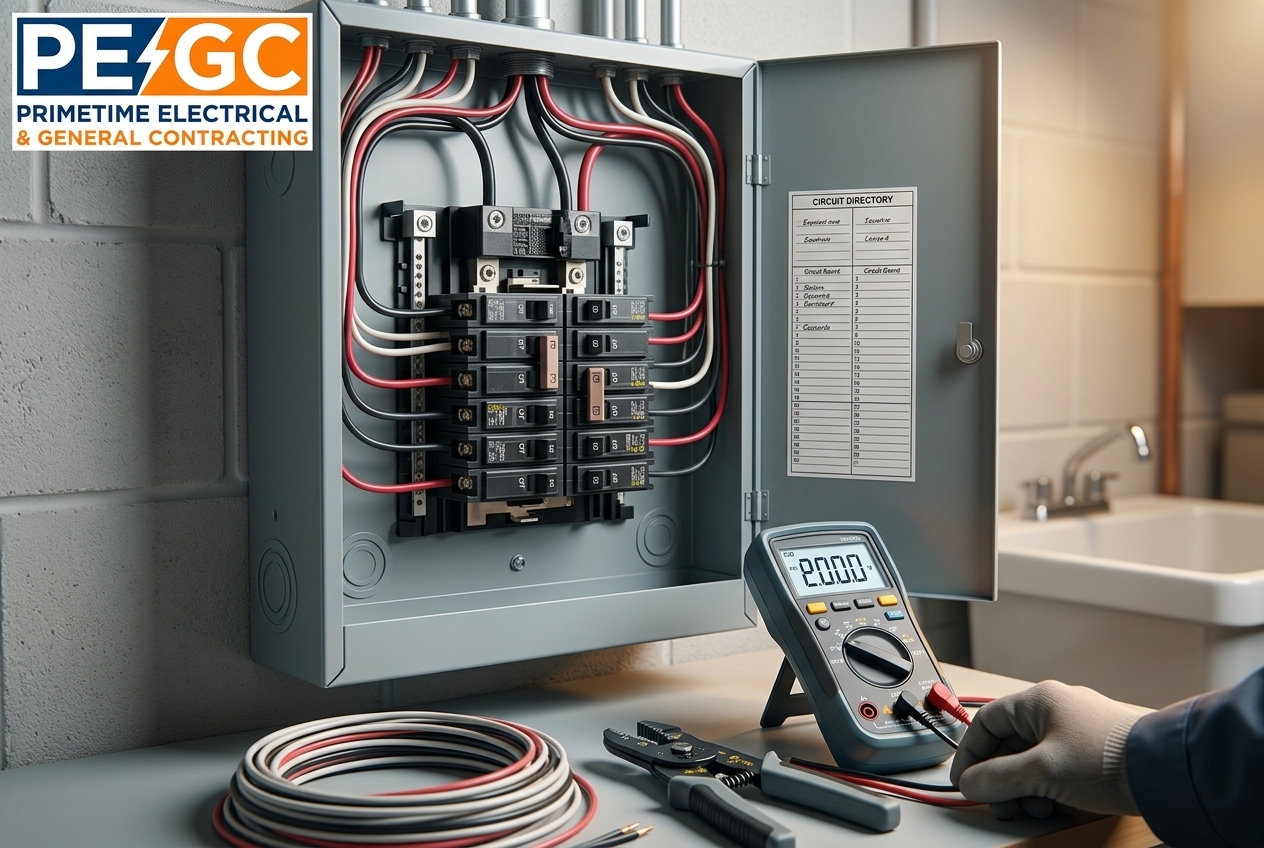
    Your electrical panel is the heart of your home’s wiring. Each breaker controls a circuit — a loop of wiring that feeds outlets, lights, or a specific appliance. A breaker’s job is to cut power the instant something goes wrong, before overheated wiring can start a fire or deliver a dangerous shock.

    So when a breaker trips, it’s not failing. It’s succeeding. Understanding which kind of fault triggered it is the key to fixing the problem for good.

    The Most Common Reasons Breakers Keep Tripping

    The Most Common Reasons Breakers Keep Tripping

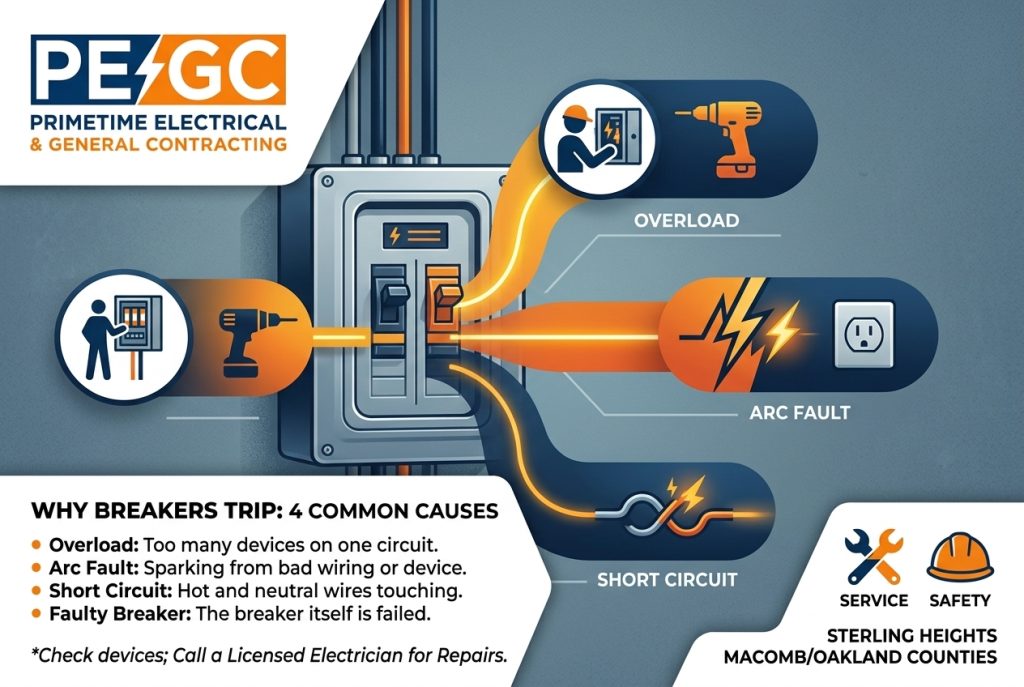
    1. Circuit Overload

    This is by far the most common cause. Every circuit has a limit — typically 15 or 20 amps in a home. When you plug in too many power-hungry devices on the same circuit, you exceed that limit, and the breaker trips to prevent the wires from overheating.

    Classic culprits include space heaters, hair dryers, microwaves, and window air conditioners — especially when several run at once. If your breaker trips every time you use the microwave and the toaster together, you’ve almost certainly found an overload.

    What you can do: Spread high-wattage devices across different circuits and outlets. If you constantly run out of capacity, though, the underlying issue is that your home simply needs more circuits or a panel upgrade.

    2. Short Circuits

    A short circuit happens when a hot wire touches a neutral wire, allowing a sudden surge of current to flow. This is more serious than an overload. You might notice a burning smell, discoloration around an outlet, or a breaker that trips the instant you reset it.

    Short circuits can come from damaged wiring, a faulty appliance, or pests chewing through insulation inside your walls. This is not a DIY fix — it requires a professional to safely locate and repair the fault.

    3. Ground Faults

    A ground fault is similar to a short circuit, but here the hot wire contacts a ground wire or a grounded part of the system — often in damp areas like kitchens, bathrooms, garages, or outdoor outlets. That’s exactly why modern code requires GFCI protection in those locations.

    If a GFCI outlet or breaker keeps tripping, it may be doing its job by detecting moisture or a genuine fault. Persistent ground faults should always be inspected, since they pose a real shock hazard.

    4. An Aging or Undersized Electrical Panel

    Many homes in Southeast Michigan were wired for a different era. If your house still runs on a 60- or 100-amp panel — or you have an older brand of panel known for reliability problems — it may simply lack the capacity for modern living: EV chargers, central air, hot tubs, home offices, and a kitchen full of appliances.

    Frequent tripping, a warm panel, flickering lights, or breakers that feel loose are all signs your panel is overdue for an upgrade. A modern panel restores capacity, improves safety, and brings your home up to code.

    5. A Failing Breaker

    Breakers don’t last forever. After years of tripping and resetting, the internal mechanism can wear out and start tripping at lower loads than it should — or fail to trip when it needs to, which is even more dangerous. A worn breaker is an inexpensive part to replace, but it should always be done by a licensed electrician.

    What You Can Safely Check Yourself

    Before calling in a pro, there are a few safe steps a homeowner can take:

    Unplug everything on the affected circuit, reset the breaker, then plug devices back in one at a time. If the breaker trips the moment a specific appliance kicks on, that appliance is likely the problem. If it trips with nothing plugged in, the issue is in the wiring or the breaker itself — and that’s your cue to call an electrician.

    What you should never do is repeatedly force a breaker back on that keeps tripping, replace a breaker with a higher-amperage one to “stop the nuisance,” or open the panel and poke around inside. Those moves remove the very protection keeping your home safe and can lead to fire or electrocution.

    When to Call a Licensed Electrician

    It’s time to bring in a professional if you notice any of the following: a breaker that trips repeatedly or won’t reset, a burning smell or scorch marks near outlets or the panel, a warm or buzzing panel, flickering lights throughout the house, or sparking outlets. These are warning signs that something more serious is happening behind your walls.

    Electrical troubleshooting is part detective work, part safety science. A trained electrician can test circuits, isolate the fault, and fix the root cause — not just the symptom — so you stop making trips to the panel for good.

    Get to the Root of It with Primetime Electrical

    Primetime Electrical and General Contracting is a locally and veteran owned, fully licensed and insured team serving Sterling Heights and more than 30 communities across Macomb, Oakland, and Metro Detroit. With 8+ years of experience and a 5-star Google rating, we diagnose tripping breakers fast and fix them right the first time — whether the answer is a simple breaker replacement, a dedicated new circuit, or a full panel upgrade.

    If your breakers keep tripping, don’t keep guessing. Call us 24/7 at (810) 397-2401 or request a free in-home estimate. We’ll find out exactly why — and make your home safe again.