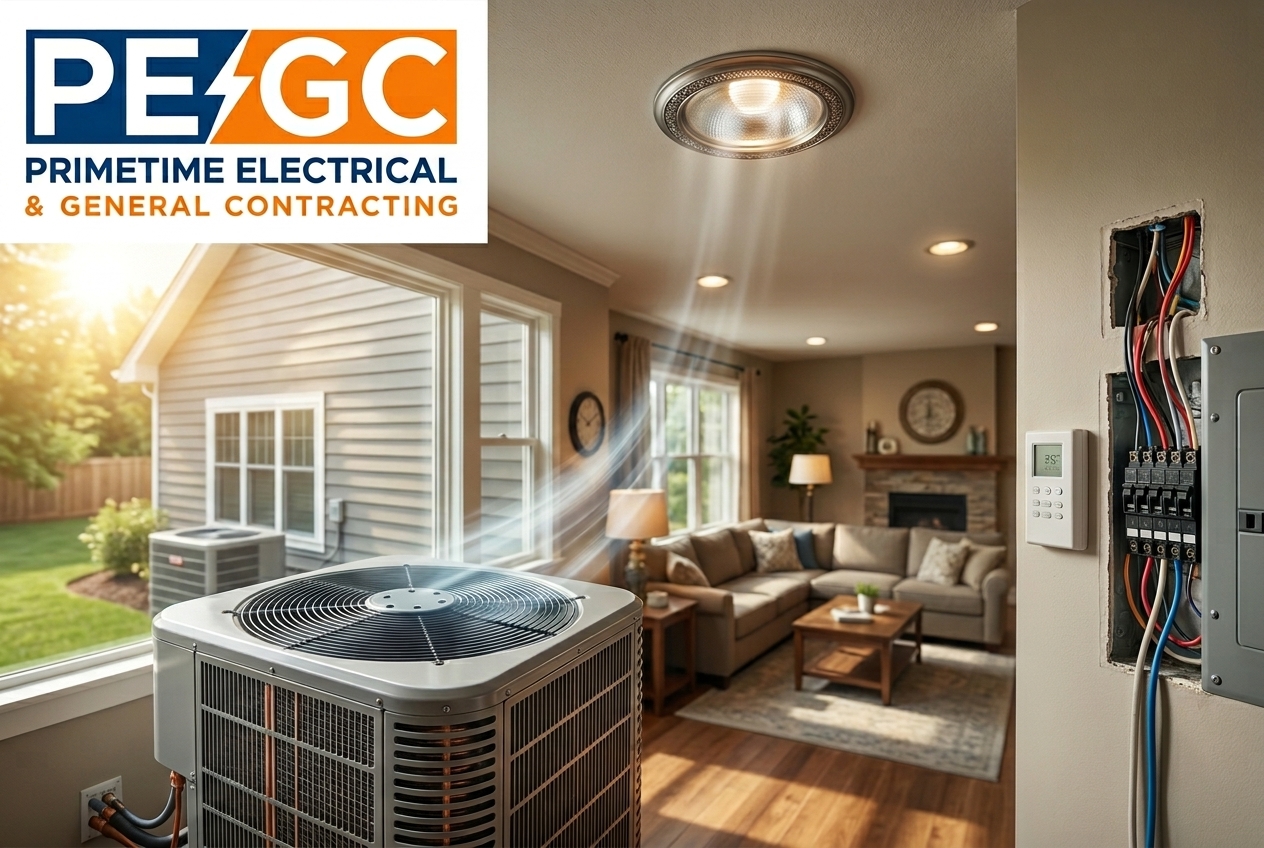
You’re sitting in the living room on a hot Michigan afternoon, the central air kicks on, and for a split second every light in the house dims. If that quick flicker has you wondering whether something’s wrong, you’re asking the right question. Sometimes it’s perfectly normal. Other times, it’s an early warning sign worth taking seriously.
At Primetime Electrical and General Contracting, we get this call all summer long from homeowners across Sterling Heights and the surrounding Macomb and Oakland County communities. Here’s why it happens, when it’s harmless, and when it’s time to have an electrician take a look.
The Short Answer: Inrush Current
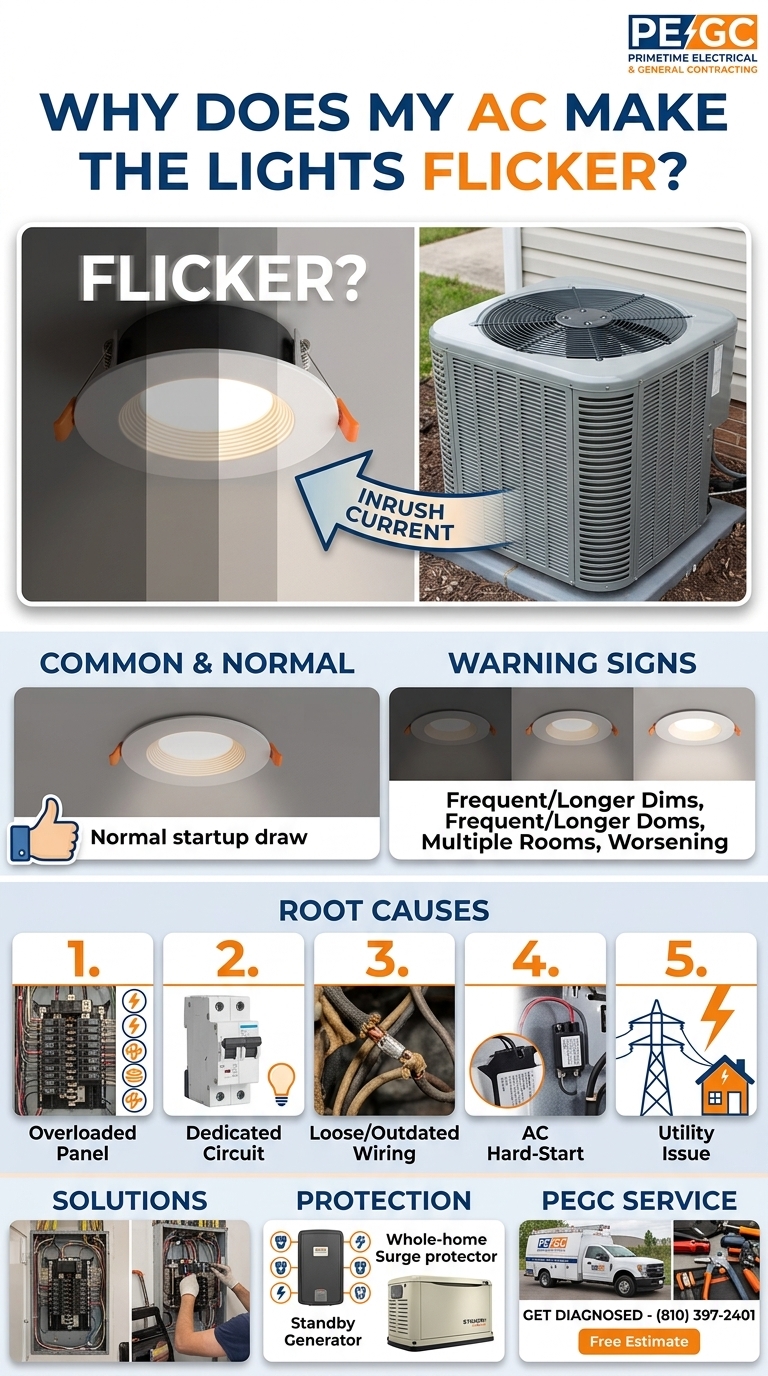
Your air conditioner’s compressor is one of the most power-hungry devices in your entire home. The moment it starts up, it pulls a large surge of electricity — often several times its normal running load — to get the motor spinning. Electricians call this “inrush current.”
That brief, heavy draw can cause a momentary dip in voltage across your home’s wiring. Lights on the same electrical system react to that dip by dimming for a fraction of a second. A quick, slight flicker right as the AC engages is common and usually nothing to worry about.
The concern is when the flickering is frequent, dramatic, or getting worse over time. That’s when it shifts from a quirk to a symptom.
When Flickering Is a Warning Sign
A healthy electrical system should absorb the AC’s startup surge with only a barely-noticeable blip. If you’re seeing any of the following, something deeper may be going on:
The lights dim noticeably or for longer than a quick flash. Multiple rooms flicker, not just the ones near the AC unit. The flickering has gotten worse over recent months. You also notice flickering when other large appliances start — the dryer, microwave, or refrigerator. Flickering comes with other symptoms like warm outlets, a buzzing panel, or breakers that keep tripping.
When the pattern looks like this, the dimming is telling you that your system is straining to deliver power. Our electrical troubleshooting team can pinpoint exactly which of the causes below is to blame.
Common Causes Behind the Flicker
1. An Overloaded or Undersized Electrical Panel
If your AC shares its electrical demand with the rest of the house through an aging or undersized panel, the system simply may not have the headroom to handle that startup surge cleanly. Many older Southeast Michigan homes were never wired for the central air, EV chargers, and appliance loads we run today.
A circuit breaker and panel upgrade increases your home’s capacity so large loads like your AC start up without dragging down everything else.
2. The AC Needs Its Own Dedicated Circuit
Central air conditioners and other major appliances should run on a dedicated circuit — a line that serves nothing else. If your AC is sharing a circuit with lighting or outlets, its startup surge will visibly affect those lights every time. Adding a properly sized dedicated circuit is a common, straightforward fix.
3. Loose or Outdated Wiring
Loose connections at the panel, at outlets, or within the wiring itself create resistance, and resistance shows up as flickering — and as a genuine fire risk. Homes with original outdated wiring are especially prone to this. If your home is a few decades old and you’ve never had the wiring evaluated, flickering is a good prompt to do so. Replacing aging wire with modern, code-compliant electrical rewiring eliminates the risk and the flicker.
4. A Hard-Start Issue with the AC Itself
Sometimes the problem is on the air conditioner’s side — a worn compressor or a failing start capacitor that makes the unit draw even more current than it should at startup. In these cases, adding a “hard-start kit” or servicing the unit reduces the surge. An electrician can help determine whether the issue lives in your wiring or in the equipment.
5. A Utility-Side or Service Problem
Occasionally the dip originates upstream — at the service connection or even with the utility. If your neighbors notice the same thing, or the issue affects the whole house equally, it may be worth investigating the incoming service. A whole-home assessment will rule this in or out.
How to Protect Your Home and Electronics
Beyond fixing the root cause, two upgrades are worth knowing about. Whole-home surge protection shields your electronics and appliances from the voltage swings that motors and outages can create. And if power reliability is a concern, a whole-house standby generator keeps everything running smoothly through outages — common during Michigan’s storm seasons.
If you ever notice flickering paired with a burning smell, sparking, or a hot panel, treat it as urgent and call our 24/7 emergency electrician line right away.
Don’t Guess — Get It Diagnosed
A quick flicker when the AC starts can be perfectly normal. But persistent or worsening flickering is your home’s way of asking for help, and it’s not worth ignoring. The only way to know which one you’re dealing with is to have a licensed electrician test the system and trace the cause.
Primetime Electrical and General Contracting is locally owned, fully licensed and insured, and 5-star rated, with 8+ years powering homes across Sterling Heights, Macomb and Oakland County, and the greater Metro Detroit area. We’ll find out exactly why your lights flicker and fix it right the first time.
Call us 24/7 at (810) 397-2401 or request your free in-home estimate today.