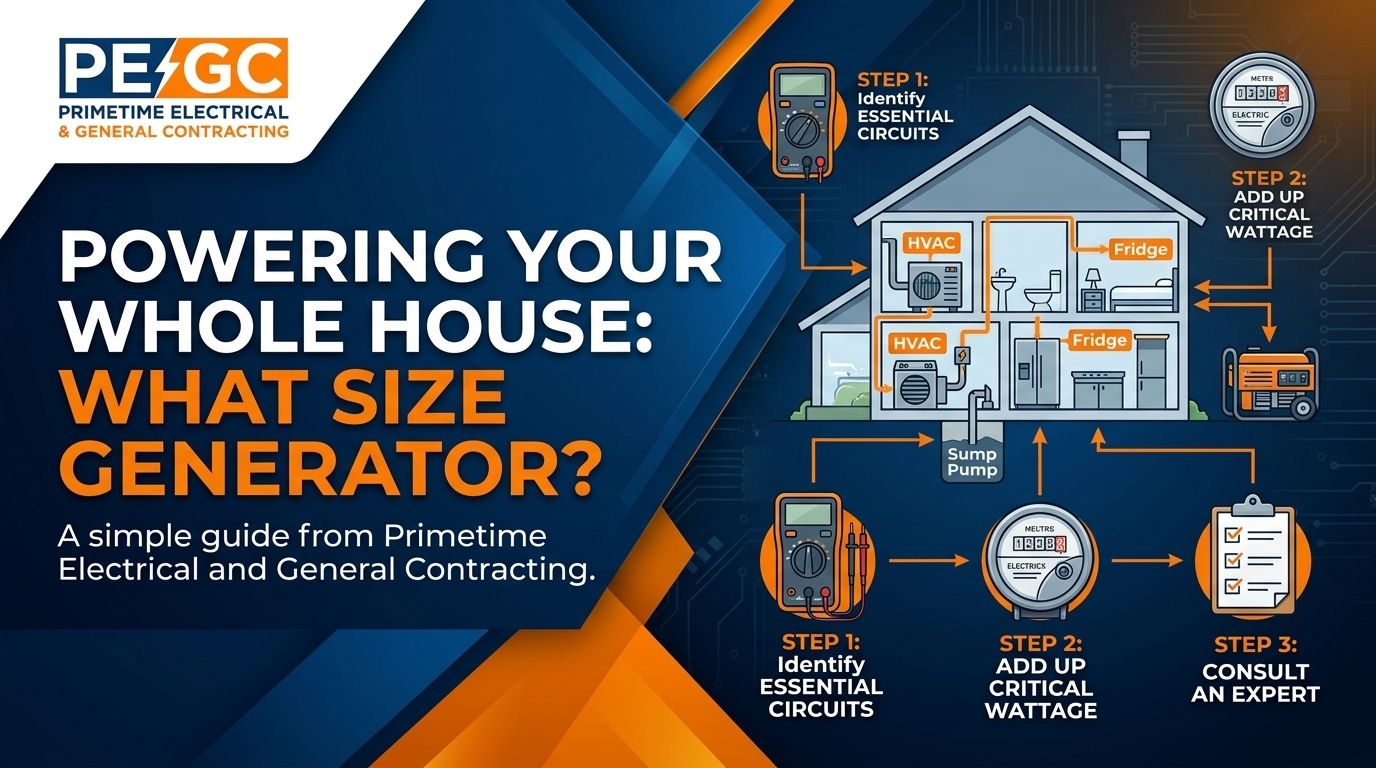
The power goes out during a January ice storm in Sterling Heights, and within an hour the house is already getting cold, the sump pump has gone quiet, and you’re watching the food in your fridge slowly warm up. You’ve thought about a backup generator for years, but every time you start shopping you run into the same wall of numbers — kilowatts, amps, watts — and you’re left wondering one simple thing: how big does it actually need to be?
It’s the most common question we hear about backup power, and the good news is that the answer isn’t complicated once someone walks you through it. At Primetime Electrical and General Contracting, we size whole house generators for Metro Detroit homes all the time, and the right size for your house comes down to a few clear factors we’ll break down below.
First, what does “power my whole house” really mean?
There’s an important fork in the road here. Some homeowners want a generator that runs everything exactly like the grid does — every air conditioner, the electric range, the dryer, all at once. Others are happy with “managed” backup that keeps the essentials running comfortably: heat, fridge, sump pump, lights, internet, and a few outlets, while you simply avoid running the dryer and the oven at the same time during an outage.
Both are completely valid, and the difference between them can be thousands of dollars. Knowing which camp you’re in is the single biggest factor in sizing, so it’s worth thinking about before you shop.
The general size ranges
For most Southeast Michigan homes, whole-house standby generators fall into a few buckets:
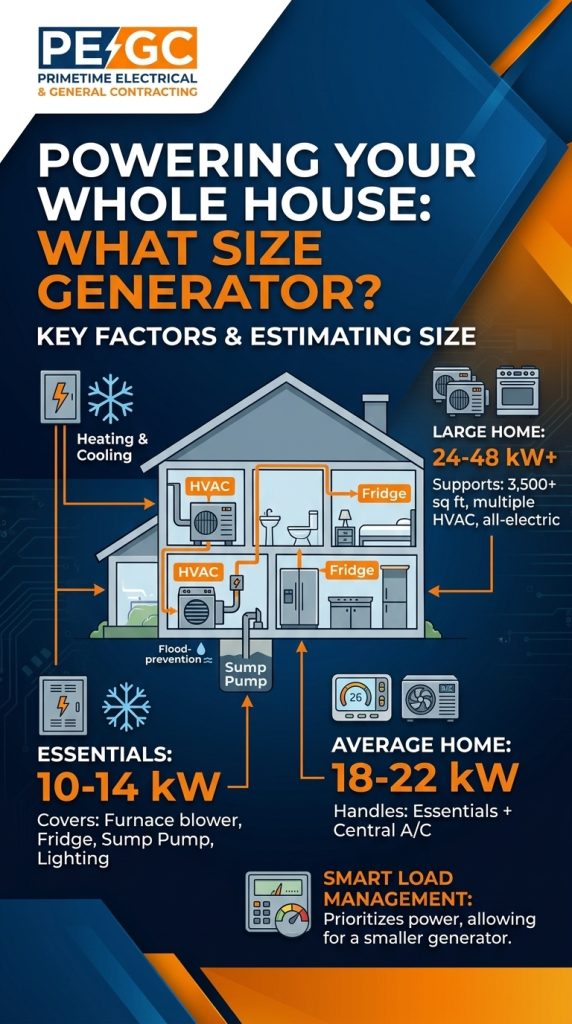
A smaller standby unit (about 10–14 kW) is enough to cover the true essentials in a typical home — furnace blower, refrigerator, sump pump, well pump, some lighting, and outlets. This is a great fit for a smaller or well-insulated home, or for homeowners who mainly want peace of mind through a winter outage.
A mid-size unit (about 18–22 kW) is the most popular choice for the average single-family home in our area. It comfortably handles the essentials plus central air conditioning, so summer storm outages aren’t a sweaty ordeal, and it allows much more normal day-to-day living without thinking hard about what’s running.
A large unit (24–48 kW or more) is what bigger homes need — think 3,500+ square feet, multiple HVAC systems, an electric range, a hot tub, a pool, or a workshop. If you want true “you’d never know the power was out” performance in a large house, this is the range.
These are starting points, not a prescription. Two homes the same size can need different generators depending on what’s inside them.
What actually drives the number
The honest answer to “how big” depends on your home’s specific loads. A few things matter most:
Heating and cooling are usually the biggest swing. A central A/C unit or heat pump draws a large surge when it starts up, and that surge often determines your minimum generator size more than anything else. Here in Michigan, a gas furnace is easy on a generator (it mostly just needs power for the blower and ignition), but central air in summer is a heavy hitter.
Large electric appliances add up fast. An electric range, electric water heater, electric dryer, or an EV charger each pull serious wattage. If your home leans all-electric rather than gas, you’ll generally need a bigger unit.
Well and sump pumps matter more than their size suggests because of their startup surge — and in our region, a working sump pump during a spring storm can be the difference between a dry basement and a flooded one.
The “everything at once” factor. It’s rarely about total wattage — it’s about peak simultaneous demand. A smart load-management system (sometimes called a load shedding module) lets a smaller generator power a big house by briefly prioritizing loads, so you can often go a size down without really noticing.
Why a professional load calculation beats a guess
You’ll find plenty of online generator calculators, and they’re fine for ballparking. But they can’t see your actual electrical panel, your appliance nameplates, the startup surge of your specific A/C unit, or whether your panel even has the capacity to support a standby system safely.
An undersized generator will overload, trip, and leave you in the dark at the worst possible moment. An oversized one means you paid for capacity you’ll never use, and it can actually run less efficiently. A proper load calculation — done by a licensed electrician who looks at your real home — gets you the right size the first time. It’s exactly why we offer a free in-home estimate rather than quoting a number sight unseen.
Don’t forget the fuel and the installation
Sizing is only part of the picture. Most whole-house standby generators in our area run on natural gas or propane, and your gas supply and meter need to be able to feed the unit you choose — another reason an in-home assessment matters. The generator also has to be tied into your home through a properly installed transfer switch, which is what safely disconnects you from the grid so the generator never back-feeds power onto the line. That part is strictly licensed electrician territory, both for your safety and for the safety of the utility crews working to restore power.
When to call a licensed electrician
Generator sizing and installation isn’t a DIY project. You should bring in a licensed pro when you’re ready to choose a unit, when you’re not sure whether your existing panel can handle a standby system, or if you have an older home where the wiring or service may need updating first. And if you ever smell gas near an installed unit, or your generator is tripping or behaving oddly during an outage, treat it as urgent and call for emergency service right away.
Get the right-sized generator for your home
Choosing a backup generator shouldn’t feel like a math test. As a locally owned, family-run business that’s licensed and insured, 5-star Google rated, and has completed over 1,200 projects across Macomb County, Oakland County, and greater Metro Detroit in our 8+ years, we’ll come to your home, run a real load calculation, and recommend the size that fits how you actually live — no overselling.
Ready to stop dreading the next storm? Call us anytime, day or night, at (810) 397-2401, or request your free in-home estimate and we’ll help you find the perfect fit for your home.